
Last updated October 21, 2026. Prices are shown in US dollars first, with pesos alongside. Unless noted, conversions use the official Banco Nación (BNA) selling rate of ARS 1,545 per dollar on October 20, 2026. I keep facts and my own opinions separate, and estimates are labelled as such.

Walk through a Buenos Aires mall these days and you keep having the same little moment: wait, they’re here now? On the clothing side, Mango is back and H&M has an opening date. But it isn’t only clothes. The same thing is happening with small luxuries like scented candles, body mists and foaming hand soap. Right in the middle of it sits an American brand many visitors know by heart: Bath & Body Works.
When I lived in Buenos Aires, from 2017 to 2024, Bath & Body Works was something you brought back from a trip abroad. On trips to New York in 2018 and 2019, I walked into a store and came out with three things, and it felt genuinely cheap. My gut feeling was that I was paying about a third of what a similar imported product cost in Argentina. Then, in January 2024, the first official store opened at Unicenter. I went, glad to finally see it, and paid somewhere around USD 30 for a single body wash. Thinking of my New York haul, I had to laugh a little at the till. Still, nobody around me thought it was a strange thing to splurge on. In Buenos Aires, a good shower gel or body mist never really counted as frivolous. Today there are three stores in Buenos Aires, plus an online shop.
In this post, I look at how Bath & Body Works got started in Argentina and how its prices compare with the US, and why. Then I turn to the Argentine body-care brands competing alongside it, and to what a wave of imported consumer goods might mean for Argentina’s economy. There’s no verdict at the end. Think of it as a coffee-table conversation, with numbers.
Key numbers at a glance:
- The first store opened on January 22, 2024, at Unicenter. There are now three.
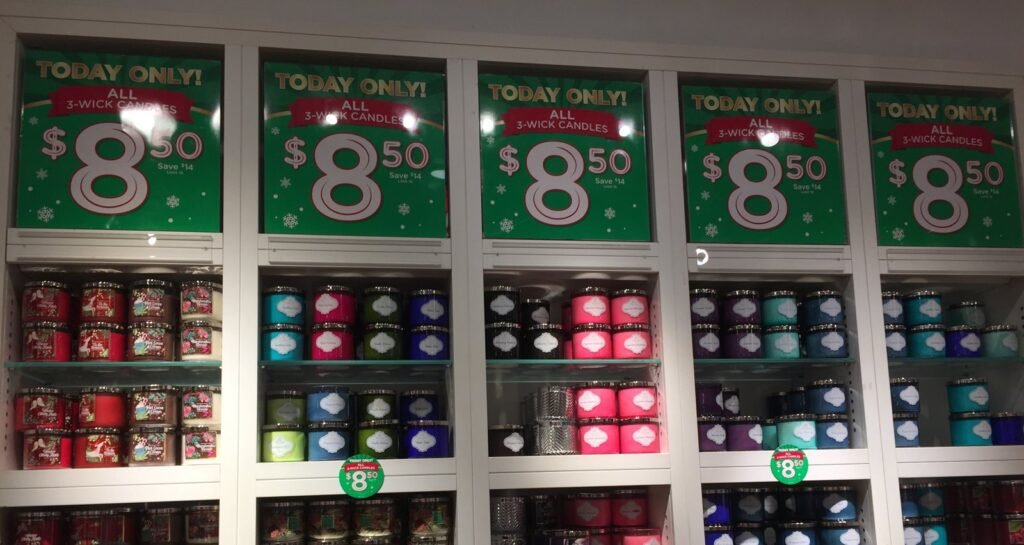
- A 3-wick candle lists at ARS 70,400 (about USD 45.57) in Argentina, against USD 24.95 in the US. That’s roughly 83% more at the shelf price.
- In 2025, Argentine residents spent USD 12.07 billion on travel abroad, leaving a USD 7.22 billion travel deficit.
- Argentina’s cosmetics, hygiene and cleaning-products industry counted 499 companies and 18,016 jobs in 2022.
How Bath & Body Works Arrived in Argentina
Let’s start with the big picture: the US company didn’t come in on its own. Bath & Body Works Argentina is run by Grupo David, a Panamanian company that holds the licence. Grupo David also brought Victoria’s Secret to Argentina, which is why you often see the two brands side by side.
According to El Cronista, the first store opened on January 22, 2024, on the first level of Unicenter in Martínez, just north of the city. It covers 100 m² and cost USD 500,000. A Grupo David executive said the launch had taken time because “all the products are imported.” He also spoke of room for as many as 15 stores in Argentina. The second and third stores followed in December 2024, at Alto Palermo and Galerías Pacífico. Alto Palermo had originally been planned for September 2024 and slipped by a few months.
I re-checked on October 21, 2026. The official online shop (bathandbodyworks.ar) still lists only those three stores as pickup points. Press reports in June 2026 said a fourth store would open at Abasto in September, but it isn’t on the official store list yet, so I’m treating Abasto as “reported but not confirmed.” In Córdoba, the Nuevocentro mall has announced an 80 m² Bath & Body Works next to a new Victoria’s Secret, opening November 11. That would be the first store outside Buenos Aires.
What was the opening like? Honestly, I found mall and trade-press stories about “enthusiastic customers,” but no concrete reports of hours-long queues, so I won’t claim there were any. What is clear is that a beauty blogger at the February 2024 launch listed body mists from ARS 33,000, and the mood was very much “finally, we can buy it here.”

My take: to me, this pace looks more like careful growth than a rush. In 2024 there was talk of 15 stores, or 10 within three years. Nearly three years on, there are three. Importing is easier now, but every new store is still a decision made with one eye on the exchange rate and the other on consumer mood. Slow, or just realistic for Argentina? What do you think?
Why Argentina Loves a Good Scent, and Why Bath & Body Works Came
One thing struck me in my first months in Buenos Aires: people smelled good. Not in a heavy, cloud-of-perfume way, just consistently. Colleagues arrived at the office with a fresh spritz of something. The commuter next to me on the subte at 8 a.m. had clearly showered with a proper scented gel. Friends reapplied perfume before heading out to dinner at ten at night. Fragrance wasn’t saved for special occasions. It was part of getting dressed.
It started young, too. In friends’ homes with small children, colonia for babies and kids was a bathroom staple. It’s a light, gentle cologne, splashed on after bath time as naturally as reaching for a towel. When it came to presents, perfume was the safe bet. For birthdays, for Día de la Madre (Mother’s Day, in October) or for the office amigo invisible (Secret Santa) at Christmas, I saw perfumes, body splashes and shower-gel gift sets change hands again and again. Every December, the perfumerías and the fragrance aisles of the pharmacy chains were among the busiest spots in the malls.
So when Bath & Body Works finally opened, it didn’t have to explain itself. From what I saw, people walked out with mists and shower gels first, and the numbers back that up. Three months after the launch, Grupo David’s vice president of operations spoke to Forbes Argentina. He said the store had “exceeded our expectations,” that they “sold much more than planned and ran short of products,” and that they “had to triple the orders.” He also explained why they came while consumption was falling: to get ahead of competitors and lock in premium mall locations. Today, the “favourites” list on the Argentine online shop is still led by body mists such as Peach Blossom & Nectar, Gingham Gorgeous and Vanilla Romance, sold with “buy 5, pay for 3” deals.

The wider data points the same way, though with gaps:
- Category size: Brazil’s Natura alone held about 32% of Argentina’s fragrance market in 2025, which gives a sense of how big the category is. There’s more on local brands below.
- Imports: the government’s sector report names perfumes, along with hair products and makeup, as the leading cosmetic imports from 2016 to 2023, mainly from France and Spain. It doesn’t break out perfume’s share of the trade deficit, so I can’t give you that figure.
- Growth outlook: the public summary of Euromonitor’s 2025 Fragrances in Argentina report expects strong growth in both volume and value. It credits the return of interest-free instalment payments in the second half of 2024, and notes that Arabian-style fragrances are starting to gain ground.
- Per-person spending: the most recent figure I could find is old but telling. CAPA and INDEC data put Argentina’s apparent consumption of cosmetics and perfumery at USD 80.2 per person in 2013, roughly triple the 2004 level (CESBA sector report). I couldn’t find a reliable, free and up-to-date per-person figure for fragrance alone.
My take: Bath & Body Works didn’t pick Argentina at random. Here, smelling nice is an everyday habit, perfume is the default gift, and plenty of people already know the brand from trips abroad. That’s about as warm a welcome as a fragrance chain can get. The open question is whether that love of scent can carry prices that, as you’re about to see, sit well above US levels. Is there a scent you never travel without?
Bath & Body Works Argentina Prices vs the US
This is the part everyone asks about. Argentine prices are the list prices on the official Bath & Body Works Argentina shop on October 21, 2026. US prices are regular list prices from the US site and from 2026 US sale coverage. Where possible, I used the same scent (Champagne Toast) and standard US sizes. The local column isn’t the same product, just a common alternative that does the same job, so read it as context.
| Item | BBW Argentina (list) | BBW US (list) | Difference | Local alternative (for reference) |
|---|---|---|---|---|
| Fine fragrance mist, 236 ml | USD 32.04 (ARS 49,500) | USD 17.95 | +78% | Farmacity Home Spa body mist 125 ml: USD 7.11 (ARS 10,990) |
| 3-wick candle, 411 g | USD 45.57 (ARS 70,400) | USD 24.95 | +83% | La Pasionaria soy candle 200 g: USD 20.06 (ARS 31,000) |
| Foaming hand soap, 259 ml | USD 14.30 (ARS 22,100) | USD 7.95 | +80% | Farmacity liquid soap 500 ml: USD 6.05 (ARS 9,350) |
| Shower gel, 295 ml | USD 30.36 (ARS 46,900) | USD 14.95 | +103% | Home Spa shower gel 350 ml: USD 5.82 (ARS 8,990) |
One thing matters a lot when reading that table. Argentine prices already include 21% VAT (IVA), while US shelf prices exclude sales tax. Helpfully, the Argentine site also shows a “price without national taxes,” so you can strip VAT out. Here’s what that looks like:
- Candle: about USD 37.66, or 51% more than in the US
- Mist: about USD 26.48, or 48% more
- Hand soap: about USD 11.82, or 49% more
- Shower gel: about USD 25.09, or 68% more
So “double” is the tax-included shelf feeling. Like for like, it’s closer to one and a half times.
Sales make a big difference too. As I write, the Argentine site has many mists, shower gels and body creams at ARS 30,000 each (about USD 19.42), plus “buy 6, pay for 3” bundles. In the US, the semi-annual sale can drop a 3-wick candle to USD 10.99. When you buy can matter as much as where.
Let me check my own memories against the numbers. I said I paid about USD 30 for a body wash at Unicenter in 2024. I don’t remember the exact peso price. Today the shower gel lists at ARS 46,900 (about USD 30.36), roughly double the US list price of USD 14.95. So that “this is expensive” feeling wasn’t just in my head.
Now for the “one third” I felt in New York. That was an impression, not a measurement. On list prices alone, Argentina is about 80% higher, which makes the US price roughly 55% of the Argentine one, a little over half. But Bath & Body Works in the US runs sales constantly. This roundup of the summer 2026 semi-annual sale lists discounts of up to 75%, shower gel from USD 3.98, 3-wick candles at USD 10.99 and a buy-one-get-one deal on one line. Foaming hand soaps regularly carry a “5 for USD 28” mix-and-match price. If I happened to shop during a sale back then, feeling like I paid a third may not have been far off. List to list, it’s about 55%. With sales, it’s somewhere around a third. That’s how I’d put it.
One more interesting detail. That February 2024 blog post had body mists starting at ARS 33,000; today mists list at ARS 46,300 to 52,100. In pesos that’s only about 1.5 times higher after more than two and a half years, while inflation in 2024 alone was 117.8% (INDEC). Looking at those numbers, the dollar price of Bath & Body Works in Argentina has actually come down quite a bit. My guess is that a steadier exchange rate, easier imports and more competition in the malls mean the brand can’t mark things up the way it once could. That is my inference, not cost data. If you want the background on how money works here now, see my guide to exchange rates, cards and cash in Argentina.
Would you buy at these prices? I’d probably hesitate on the candle, but I could see myself picking up a travel-size gift or a mist on promotion.
Why Imported Body Care Costs More in Argentina
Broadly, the price of imported cosmetics in Argentina stacks up in three layers:
- Import duty. Cosmetics typically pay around 18% under the Mercosur common external tariff, and some lines pay 25%.
- Customs costs and taxes. These include a 3% statistics fee and 21% VAT. Importers also pay advance VAT (20%) and advance income tax (6%) at customs. Those can be recovered or credited later, so they aren’t pure cost, but they tie up cash, and that tends to show up in prices.
- The importer’s margin.
Some changes have pushed the other way. In May 2025, Resolution 31/2025 scrapped the prior import authorisations required for cosmetics, personal hygiene products and perfumes, making imports much easier. Registration with ANMAT, Argentina’s health products regulator, is still required.
Personal imports opened up too. Under ARCA’s courier rules, each shipment up to USD 400 FOB is exempt from import duty and the statistics fee. You can do this up to five times per person per year, though you still pay 21% VAT. The catch is that the US Bath & Body Works site only ships to US addresses, so you need a forwarding service. Bath & Body Works also notes that aerosol and alcohol-based items may be restricted for shipping. Mists contain alcohol, and candles are heavy and breakable, so shipping costs add up fast. For this brand, a suitcase is still the easier route.
Suitcases have rules too. ARCA’s traveller allowance lets you bring in up to USD 500 per person per month in goods bought abroad when you arrive by air, and you pay 50% on anything over that. Twenty 3-wick candles at US list price still come in under USD 500, which is exactly why buying on a US trip keeps its appeal.
None of this seemed to put people off. As I said earlier, in Buenos Aires a little makeup and a nice scent were simply part of getting dressed, and that everyday habit is exactly what Bath & Body Works is selling into.
My take: because of all this, I suspect the real competitor for Bath & Body Works’ Argentine stores is often not a local brand. It’s the suitcase coming home from a US trip. What the stores can win on is immediacy: buying today, smelling the scent in person and paying in cuotas (instalments). Would you pay roughly 1.5 times more to buy now, or wait for your next trip?
Argentine Body-Care Brands: Imported vs Local
This part surprised me a little. The big picture is that Argentina’s body-care leaders aren’t local companies. Euromonitor figures reported by Bloomberg Línea put Brazil’s Natura first in Argentine beauty and personal care in 2024, with a 21.9% share, and Natura held 32% of fragrances in 2025. Multinationals such as Unilever and L’Oréal follow. Many brands that feel very local turn out to be Brazilian or multinational.
Import data tells the same story. CEPA, an economic think tank working from customs (ARCA) records, looked at the top toiletries importers from January to September 2025. They were Natura (USD 45.0 million), Unilever (USD 35.7 million) and L’Oréal (USD 32.1 million). Several multinationals that hadn’t imported at all in 2023 started doing so.
So what about genuinely Argentine brands? Here are the ones I could confirm:
- Algabo: an Argentine company founded in 1989, with a plant in Tortuguitas, Buenos Aires province. It makes everyday lotions, deodorants and similar products.
- Dermaglós: owned by Laboratorios Andrómaco, an Argentine pharmaceutical company more than a century old. A 300 g body cream costs about ARS 30,950 (USD 20.03) at pharmacies.
- Farmacity Home Spa: the pharmacy chain’s own label, covering body mists, shower gels and diffusers. As the table shows, it costs a quarter to a fifth of Bath & Body Works prices. I couldn’t confirm where Home Spa products are made.
There are smaller spa-style brands too:
- La Pasionaria: an Argentine family company in business since 2003. In 2025 it opened a new 650 m² plant in Rosario with capacity for 150,000 soy candles a year. Its scents have a very Argentine feel, like alfajor and dulce de leche.
- Sabater Hnos.: a soap-making family business dating back to 1943. A 2015 La Nación piece presented its Palermo shop on Gurruchaga Street, with its brightly coloured, strongly scented soaps, as the benchmark in the field.
- Small online makers: plenty of candle makers sell on Instagram and Tiendanube. Todai, for example, sells vegetable-wax candles for ARS 31,200 (about USD 20.19).
One correction to my own starting list: Cuesta Blanca, which I’d noted down as a body-care name, turned out to be a women’s clothing chain. It now imports 90% of its garments from China. A local brand doesn’t always mean local production.
Here’s the picture these numbers paint for me. Local spa-style brands clearly exist, and they often cost less than half of what Bath & Body Works charges. But in market-share terms, they barely register. None of the sources I found gave a separate share for these small brands. That may itself suggest they’re too small to show up in the statistics, though that last part is my interpretation.
Why is it so hard for them? The government’s 2024 report on the cosmetics, hygiene and cleaning industry offers some clues. Many of the industry’s inputs are imported, and cosmetics and personal hygiene have run a trade deficit every year since 2018 except 2020. In 2023, the sector’s overall deficit was USD 411.1 million, and 62.1% of it came from cosmetics and personal hygiene. In other words, dollars are already leaving the country to pay for fragrances, packaging and raw materials. The same report notes that the cosmetics segment is actually dominated by Argentine small and medium-sized firms. Since 2020 they have been competing with multinationals through social media and their own online shops. So “there are no local brands” isn’t right. “They exist, they’re small, and they’re hanging on” is closer.
The industry itself sounds more worried. CAPA, the cosmetics industry chamber, told El Cronista that activity fell 12–13% in 2024 and 5% in 2025, and was essentially flat (−0.06%) in the first quarter of 2026. Its inspections found violations, such as products lacking registration or traceability, in 81% of the Buenos Aires shops checked. A formal company pays around ARS 1 million for sanitary registration alone, plus ARS 6–7 million a month for a mandatory technical director. Separately, the perfumery retailers’ chamber says roughly one shop closes every month.
So who buys local? From what I saw, people who love natural or handmade things kept buying La Pasionaria and neighbourhood candle makers, as did people looking for a gift that felt Argentine. Price-sensitive shoppers simply reached for the pharmacy’s own brand or something like Algabo. The fans are real. Whether they overlap with Bath & Body Works shoppers, I’m not sure, because much of what people buy at Bath & Body Works is the “American scent” itself.
When you travel, do you go looking for local brands, or stick with names you know?

What More Imported Brands Like Bath & Body Works Mean for Argentina’s Economy
For foreigners, this is honestly good news. Visitors and long-term residents alike can buy familiar brands at the quality they expect, without waiting for a trip abroad. Compared with my years there, that’s a big change. But is it simply good news for Argentina, too? Here I’ll lay out the different sides and leave the judgement to you.
Consumers. Choice is up, and dollar prices are coming down. The government’s position is clear. Economy Minister Luis Caputo was responding to industry criticism. He said that making Argentines pay “two, four, ten times” the value for lower-quality goods is “immoral and unfair.” He added that his job is to defend the interests of 48 million Argentines, not those of particular business owners.
Spending abroad. INDEC balance-of-payments data, as reported by La Nación, show that Argentine residents spent USD 12.07 billion on travel abroad in 2025. Foreign visitors spent USD 4.85 billion in Argentina, leaving a USD 7.22 billion deficit. Lorenzo Sigaut Gravina of the consultancy Equilibra pointed to the real appreciation of the peso and the closing of the exchange-rate gap. In INDEC’s travel survey, shopping accounted for 17.6% of outbound travellers’ spending. In theory, when brands like Bath & Body Works open locally, some money that would have been spent abroad can shift to local stores. That would keep jobs, rents and taxes at home. How much actually shifts, the data I found can’t say.
But the dollars still leave. Everything Bath & Body Works sells in Argentina is imported, so dollars once spent on a trip may simply become import payments instead. Cosmetics were already a deficit item in the trade balance, and more imports could widen that gap. Honestly, this is the part that worries me a little.
Local manufacturing and jobs call for even more care. The industry counts 499 companies and 18,016 jobs (2022). That’s not huge, but it’s made up mostly of small and medium firms. Martín Rappallini, head of the Argentine Industrial Union (UIA), has said that “industry competes with the world but pays Argentine costs.” He says the UIA isn’t against opening up. What it wants is a “bridge” of conditions that would let it compete: credit, a lighter tax burden and a crackdown on smuggling. In September 2026, the UIA handed the Economy Ministry a document with 38 such requests. Reports said no concrete measures were announced at the meeting.
Retail and malls see a different picture. Foreign brands fill empty units, pay rent and create store jobs. Brands like Bath & Body Works, Victoria’s Secret and Mango are run by franchise operators such as Grupo David and Grimoldi. That means part of the profit goes to those companies, and to royalties abroad. On taxes, formal imports pay duty and VAT, while personal courier imports skip duty up to USD 400. A shift toward couriers could therefore mean less duty revenue. That’s the general logic; I didn’t find a study that puts a number on the actual tax effect.
Quality and competition. There’s hope that competition will lift quality. In fashion, Cuesta Blanca says it is rebranding and improving quality to compete with foreign labels. In body care, brands like La Pasionaria compete on packaging and on the stories behind their scents. On the other side is the fear that small firms that can’t keep up will close, speeding up deindustrialisation. Industry groups say industrial output is already 10% below 2022 levels and that 90,000 registered industrial jobs have been lost (UIA figures, reported by Bloomberg Línea). For the clothing side of the same story, see my posts on H&M coming to Argentina and Mango’s return to Alto Palermo.
So what do I think? To be clear, this part is opinion. In the short run, consumers do seem to come out ahead. The hardest task, I think, falls to the local brands caught in the middle, between cheap everyday products and the imported brands people dream about. The ones that make it will probably be those selling something distinctly Argentine rather than copying Bath & Body Works. Of course, I could be wrong.
Where do you lean: cheaper, wider choice first, or local factories and jobs first?
Tips for Buying Bath & Body Works in Buenos Aires
If you really want Bath & Body Works in Argentina, check that week’s promotions on the official online shop first. A deal like “ARS 30,000 each” narrows the gap with US list prices a lot. You can also order online and pick up at any of the three stores. Moving between malls, checking maps, comparing prices and paying by QR all need mobile data. If you’re only in town briefly, a data-only eSIM such as Simsima’s Argentina plans is one option (it gives you no local phone number). That’s an affiliate link, so I may earn a commission at no extra cost to you.
Heavy, breakable things like candles are still cheapest in a suitcase, but keep the USD 500-a-month allowance in mind. And if you’re visiting Argentina, there isn’t much reason to buy Bath & Body Works here. A La Pasionaria candle or a handmade soap is a more interesting souvenir; just check your airline’s rules on candles first. For a broader sense of everyday costs, my Buenos Aires cost of living breakdown is a good companion.
FAQ: Bath & Body Works Argentina
How many Bath & Body Works stores are there in Argentina?
As of October 21, 2026, the official site lists three: Unicenter, Alto Palermo and Galerías Pacífico. Abasto was reported for September but isn’t confirmed, and Nuevocentro in Córdoba is reported to open on November 11.
Can you buy Bath & Body Works online in Argentina?
Yes, at bathandbodyworks.ar, with home delivery or in-store pickup.
How much more expensive is Bath & Body Works in Argentina than in the US?
At tax-included shelf prices, 78% to 103% more, depending on the item. With VAT removed, it’s about 48% to 68% more. Promotions can shrink the gap considerably.
Is it cheaper to order from the US site?
The US site only ships to US addresses, so you’ll need a forwarder. Courier shipments are duty-free up to USD 400 each, but you still pay 21% VAT. Alcohol-based items like mists may be restricted.
Are there good Argentine alternatives?
For candles, La Pasionaria. For soap, Sabater Hnos. At the pharmacy, Dermaglós and Algabo are Argentine companies. Farmacity’s Home Spa is a good-value own brand. Natura is huge in Argentina, but it’s Brazilian.
Final Thoughts
Bath & Body Works arriving in Argentina looks like a small story. But it captures a lot of what the country is weighing right now: cheaper, wider choice, dollars heading abroad, and local makers trying to hold on.
Will the suitcases coming home from US trips get lighter, or will local candle makers grow? Nobody knows yet. I’ll leave the judgement to you