
Last updated November 11, 2026. Peso amounts are converted at the Banco Nación (BNA) selling rate of ARS 1,570 per dollar on November 11, 2026. Brazilian real amounts are converted at USD 1 = BRL 5.52, the Frankfurter (ECB) rate on November 9, 2026.
If you have even two free days from Buenos Aires, someone will tell you to add Iguazu, and then the next question arrives in almost the same words every time: which side should I go first — Brazil or Argentina? Do you need both? Is one “better”?
I lived in Buenos Aires from 2017 to 2024, and I am not going to pretend this is a walk-by-walk diary of a single visit. The useful answer is still fairly stable, and in 2026 there is one fact you should not skip: on the Argentine side, the Devil’s Throat walkway — the Circuito Garganta del Diablo — is closed.
Quick answer: If you have two days, see both sides. The Brazilian side is shorter and gives you the wide, head-on panorama. The Argentine side is a fuller day of walkways and trails, looking along and over the falls. As of November 11, 2026, the official Argentine park site still lists the Devil’s Throat circuit as closed, as a precaution because of high water on the Iguazú River. Upper and Lower circuits have been staying open; always recheck before you travel. U.S., Canadian and Australian passport holders need a Brazilian e-visa even for a day trip across the border. British and most EU citizens do not, for ordinary short tourist stays — check the official list for your passport.
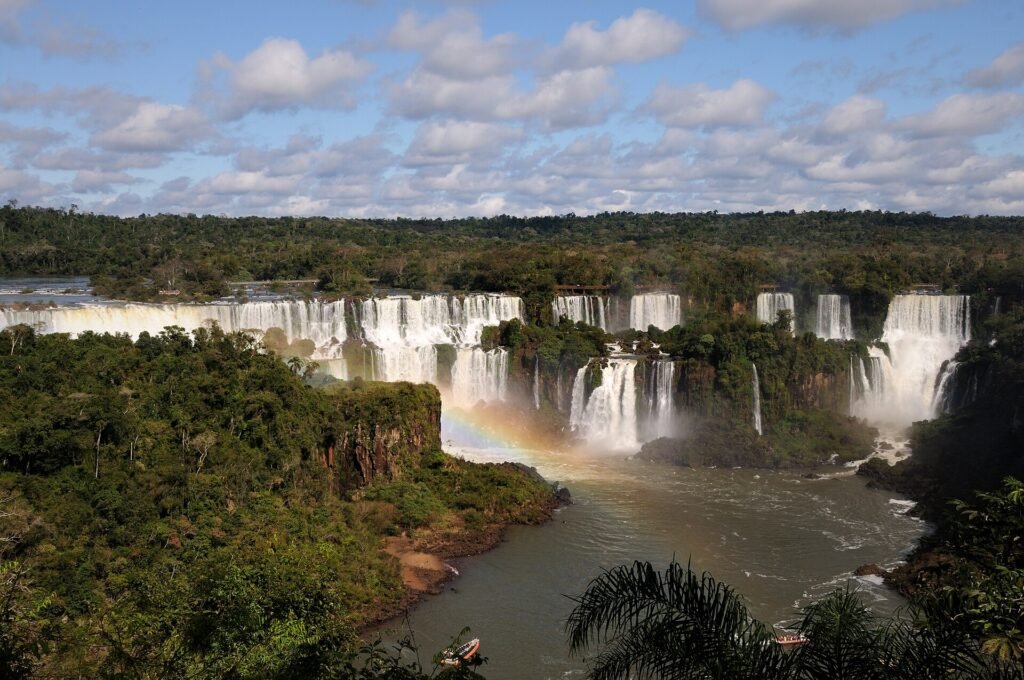
Which side should I go first — and do I need both?
The consensus among visitors is consistent enough to trust, and it has not really changed: the two parks are not the same experience. Brazil is the postcard — a relatively short visit, a clear path, and the falls spread out in front of you. Argentina is the longer day — more walking, more angles, more of the river and the forest, and (when it is open) the walkway out to Devil’s Throat.
If you have two full days, do both. A pattern that works for a lot of people is Brazil first, so the panorama is in your head before you walk the Argentine circuits, then a full day on the Argentine side. If you have only one day, there is no single right answer. Choose Brazil if you want the wide view and a less strenuous visit. Choose Argentina if you want to spend the day walking and you have checked that the trails you care about are open.
You do not automatically need a guide inside either park. You do need a way to get there, your passport if you are crossing the border, and — this year — a clear idea of what is closed.
What’s closed in 2026: Devil’s Throat on the Argentine side
As of November 11, 2026, the official concession page for the Argentine park lists the Circuito Garganta del Diablo as closed — a preventive closure because of high flow on the Iguazú River (Iguazú Argentina, Circuito Garganta). The walkway was taken down in early August 2026 as a precaution; some reports at the time mentioned a period of around 40 days, but the official status is still closed more than two months later. There is no reliable public reopening date in front of me, so treat “closed” as the current fact and look at that same page again before you book.
The rest of the Argentine park has generally stayed open — the Upper and Lower circuits, other trails such as Sendero Verde and Sendero Macuco, and the ecological train — according to the park and provincial tourism notices when the closure was announced. That can change with water levels too. Some tour listings still describe Devil’s Throat as if you will walk it; that may be out of date. Confirm with the operator, or buy a standard park ticket and walk the circuits that are actually open.

How the two parks differ in practice
On the Brazilian side, the main visit is essentially one trail (the Trilha das Cataratas), with buses inside the park from the visitor centre, elevators, and a walkway that gets you into the spray. It is often done in a few hours, not a full hiking day. You will get wet if you go to the end; a light rain jacket or a cheap poncho is more useful than a formal rain outfit, and you should assume phones and cameras need a bit of protection.
On the Argentine side, you are choosing among circuits. The Upper Circuit stays high, looking over the drops. The Lower Circuit goes down and involves stairs. Devil’s Throat, when it is running, is a separate walkway usually reached by the park train. That is a longer, hotter day in summer, with more walking on metal grates that can be slippery. The park is also where people tend to see more wildlife — coatis especially, which will go for food if you let them. Don’t.
Boat rides and some longer trails are extra, on both sides, and are not part of the basic entrance ticket. I have not independently verified 2026 boat-tour prices here, so I am leaving them off rather than guessing.
Tickets and prices, as of November 2026
The two tickets are separate. An Argentine ticket does not get you into the Brazilian park, or the other way around.
Argentina — Parque Nacional Iguazú. From 1 June 2026, the general tariff (the one that applies to most foreign visitors) is ARS 60,000, about USD 38. Argentine residents pay ARS 25,000 (about USD 16), and Misiones residents pay ARS 8,000. A second consecutive day is typically half price if you have the first ticket validated on the way out, and use it within 72 hours. Cash and Visa/Mastercard are listed as accepted. Buy through the official park channels (National Parks tariff page; also Iguazú Argentina tickets).
Brazil — Parque Nacional do Iguaçu. For 2026, the foreigner (“integral”) ticket is R$ 131, plus an optional R$ 3 contribution to a local tourism fund, so the amount you often see at checkout is R$ 134 — about USD 24. Visitors from Brazil and Mercosur countries, including Argentina, pay a lower rate (R$ 118, or R$ 121 with the contribution). Tickets are sold online, for a date and time slot, on the official site; do not assume you can just turn up and pay cash at the gate (official 2026 tariff notice; booking via tickets.cataratasdoiguacu.com.br).
If you would rather book a packaged tour with transport from Puerto Iguazú, Tiqets lists Iguazu tours on both sides. That’s an affiliate link, so I may earn a commission at no extra cost to you. Read the inclusions carefully. Some Argentine-side tours still mention Devil’s Throat as if it were open; as of November 11, 2026, the official walkway is not. Official park tickets are the straightforward way to enter, and they are what I would buy first unless you specifically want a hotel pickup and a guide.
Getting there from Buenos Aires, and crossing the border
Most visitors fly. Aeroparque (AEP) and Ezeiza (EZE) both have connections toward Puerto Iguazú (IGR) on the Argentine side; Foz do Iguaçu (IGU) serves the Brazilian side. I compare those fares on Kiwi. That’s an affiliate link, so I may earn a commission at no extra cost to you. For how domestic flights in Argentina actually work in 2026, use the domestic flights guide — this post will not repeat that airline landscape. Long-distance buses exist too, and they take the better part of a day; fly if your time is short.
You can stay in Puerto Iguazú and cross to Brazil for the day, or the reverse. The usual road crossing is the Tancredo Neves Bridge (Ponte da Fraternidade / Puente Internacional Tancredo Neves). Take your passport. You will clear immigration in both directions. Taxis and local buses run the crossing; I am not going to invent a 2026 fare or a bus number I have not checked this week. Leave more time than you think, especially in peak summer hours, and do not cut it fine against a same-day flight.
If you lean on your phone for maps once you cross, remember that an Argentine SIM or eSIM does not automatically work in Brazil. Simsima has a data-only Brazil eSIM (plans started at USD 1.50, or USD 3.92 for 1 GB over 7 days, when I checked on November 11, 2026). That’s an affiliate link, so I may earn a commission at no extra cost to you. It will not give you a local Brazilian number. Check that your phone is unlocked and supports eSIM first.
Brazil entry rules in 2026 — especially if you hold a U.S. passport
This is the part that still catches people out, including travelers who are only hopping across the bridge for a few hours.
United States, Canada and Australia. Since 10 April 2025, these passports need a visitor visa to enter Brazil, including for tourism and transit. The practical route is a Brazilian electronic visitor visa (e-visa / VIVIS), applied for online through VFS Global, which is the platform the Brazilian government has authorized for this. Official consular pages updated in 2026 describe a fee of USD 80.90, a visa valid for up to five years with multiple entries, and stays of up to 90 days. Applications are online; you should have the e-visa approved before you travel. There is no expedited option mentioned on those pages (Brazilian Ministry of Foreign Affairs, e-visa page, updated 29 October 2026; apply via brazil.vfsevisa.com).
United Kingdom. British citizen passport holders can visit Brazil without a visa for up to 90 days for tourism, according to UK government travel advice. Your passport should have at least six months left when you arrive (GOV.UK, Brazil entry requirements).
EU and other passports. Many EU and Schengen passports remain visa-exempt for short tourist stays, but I am not going to list every nationality as if the rules were identical. Check the official Brazilian table for your own passport before you book the crossing. Rules change, and a day trip is still an entry into Brazil.
Coming back into Argentina is a separate question. Most of the readers this blog is written for — U.S., UK, EU, Canadian and Australian visitors — can enter Argentina as tourists without a visa for a limited stay; the details are in the Argentina tourist visa guide. A same-day return across the bridge is normally fine if you are still inside that stay. Carry the same passport you used to enter Argentina, and do not assume an expired e-visa stamp problem on the Brazilian side is “just a day trip.”
For paying in either country, cards are widely used, but it still helps to understand the current exchange-rate picture: see Argentina exchange rates in 2026. I would not plan this trip around opening a local account.
Heat, spray and a realistic two-day outline
Summer at Iguazu is hot, humid and wet in two senses: the climate, and the walkways. Start early, take water, use sunscreen and repellent, and do not treat this as a gentle indoor morning. If you are using Iguazu as an escape from a Buenos Aires heat wave, it is a different kind of heat, not an escape from heat altogether. The Buenos Aires summer guide is the place for the city side of that problem.
A simple plan that respects the closed walkway: fly in the afternoon or evening, do the Brazilian side the next morning (book the timed ticket first), cross back, and give the Argentine park a full second day on the Upper and Lower circuits. If Devil’s Throat has reopened by the time you go — check the official page — you may want to put that first in the cooler morning. If it is still closed, you have not wasted the trip; you have just seen a slightly different park from the one older photos describe.
FAQ
Which side should I go first, Brazil or Argentina?
If you have two days, Brazil first for the panorama, then a full day in Argentina, is a sensible order. If you have only one day, pick the experience you want: the wide view (Brazil) or a longer walk among the falls (Argentina) — and check that Devil’s Throat is actually open if that is your reason for choosing Argentina.
Do I need both sides?
You can have a memorable visit with only one, but they are not substitutes for each other. Two days, one on each side, is the version I would book if the flights work.
Is Devil’s Throat open?
Not on the Argentine side, as of November 11, 2026. The official page lists the circuit as closed because of high river flow. Recheck before you travel.
Do I need a guide?
Not automatically. You need transport to the park, a ticket, and your passport if you are crossing the border. A guide is a convenience, not a requirement for the main circuits.
Do U.S. citizens need a visa just to see the Brazilian side for a few hours?
Yes. Since April 2025, U.S., Canadian and Australian passport holders need a Brazilian visitor visa. The e-visa is the usual route. Get it before you travel. UK visitors on a British citizen passport do not need a visa for short tourist stays, with the usual passport-validity rules.
How many days do I need?
One day is enough for a single side. Two days is the comfortable version if you want both. The towns are fine overnight bases; I would not block out four days at the falls unless you have a particular reason to linger.
Related reading: Domestic Flights in Argentina 2026 · Argentina Tourist Visa 2026 · Argentina Exchange Rates 2026 · Buenos Aires in Summer
Ticket prices, park closures and visa rules were checked on November 11, 2026, and they change. This is not legal or immigration advice. Recheck official pages before you book or travel.