
The short version, because that is what you came for: on an Argentina tourist visa — which is not technically a visa at all, more on that in a second — US, UK, Canadian, Australian and most EU passport holders get up to 90 days. Before those 90 days run out you can apply for another 90. That is roughly six months, legally, and then you either move onto a residency track or you leave.
Everything interesting happens in the grey zone in between. What if you just let the clock run out? Does a day trip to Uruguay buy you a fresh 90 days? That part got quietly harder starting in 2025.
I’ve lived in Palermo, Buenos Aires since 2017. I am not a lawyer and this is not legal advice. What I’ve done instead is go through the Dirección Nacional de Migraciones pages and the actual decree text in the Boletín Oficial, and separate what is documented from what isn’t. The agency sites that rank for this search rarely bother with that distinction.
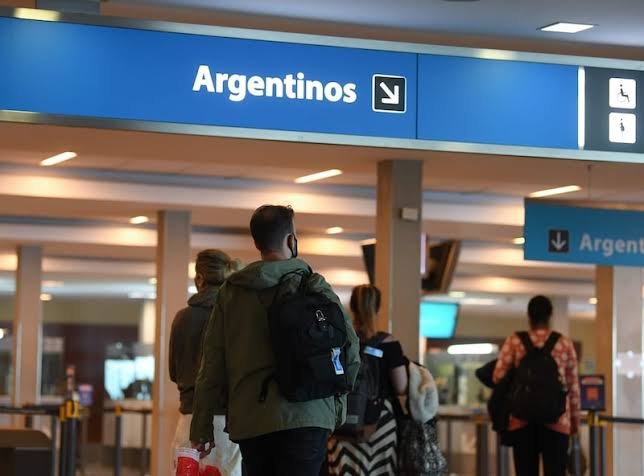
The 30-second version
| Question | Answer |
|---|---|
| Standard tourist stay | Up to 90 days (three months) |
| Can it be extended? | Yes — one further period of the same length |
| When to apply | Within the 60 days before your stay expires |
| Applying late | Fee plus a 50% surcharge |
| If you overstay | You need an exit permit (habilitación de salida), valid 10 days from payment |
| Does a visa run reset it? | Not guaranteed. Re-entry is a decision, not a right |
| Health insurance | You are required to declare that you have medical cover on entry |
Your Argentina tourist visa isn’t actually a visa
Worth getting the vocabulary right, because it changes what you search for and what you say at the counter.
If you hold a US or UK passport, you don’t need a visa to enter Argentina as a tourist. What you receive at the airport is an entry permission — formally a residencia transitoria, categoría turista.
Migraciones defines a tourist as a foreigner entering “for rest or recreation, with an authorised stay of up to three (3) months, extendable for another similar period.”
So the structure is 90 + 90. Not 180 up front. Not an open-ended arrangement you renew forever.
One detail that catches people out: Argentina stopped stamping passports at airports and ports in 2022. Your entry is recorded electronically, so there is nothing in your passport to glance at later. The officer is also not obliged to give you the full 90 days. Ask at the desk how many days you’ve been given, and afterwards download the free record of your latest crossing from the Migraciones website (the “Consultar tránsitos internacionales” service). That may be the single most practical line in this article.
Argentina tourist visa for US and UK citizens: what your own government says
Your own government’s travel pages are worth a look, because they set the passport rules your airline will check before you even board:
| US citizens | UK citizens | |
|---|---|---|
| Visa for tourism | Not required for visits of 90 days or less | Not required for tourism up to 90 days |
| Passport validity | Valid at the time of entry | Valid for the proposed length of your stay |
| Blank pages | At least 1 blank page | No specific number stated |
| On extending | Not covered | Get advice from Argentina’s Migration Office before your current stay ends |
| Source | US State Department country page | UK Foreign Office (FCDO) travel advice |
Neither page covers the extension process in any detail. For that, the Argentine side is the one that counts, and that’s what the rest of this article is about.
How long can you stay in Argentina — and how the extension works
The extension is called a prórroga de permanencia. Use the Spanish term when you ask about it; “extension” will get you a blank look.
Three rules that matter:
You apply before it expires. Official guidance is to file within the 60 days before the stay expires. Turning up afterwards and asking for an extension isn’t a thing that exists — at that point you are in a different process entirely, and it is the exit process.
Filing late costs 50% more. Where a late application is made voluntarily, a 50% surcharge applies to the fee.
Where you go. Official guidance points to the DNM headquarters in Retiro, Buenos Aires (Building 3, 08:00–13:00) or a regional immigration office. You bring a valid passport (or Mercosur ID) and the fee.
Can you do it online? Argentina has been steadily shifting immigration paperwork onto online platforms (TAD, RaDEX). Whether the tourist-category extension is among them in 2026, I could not confirm from an official source while writing this — the dedicated government page wouldn’t load. I’m not going to tell you it works online when I haven’t verified it. Check the Migraciones site, or ask at Retiro.
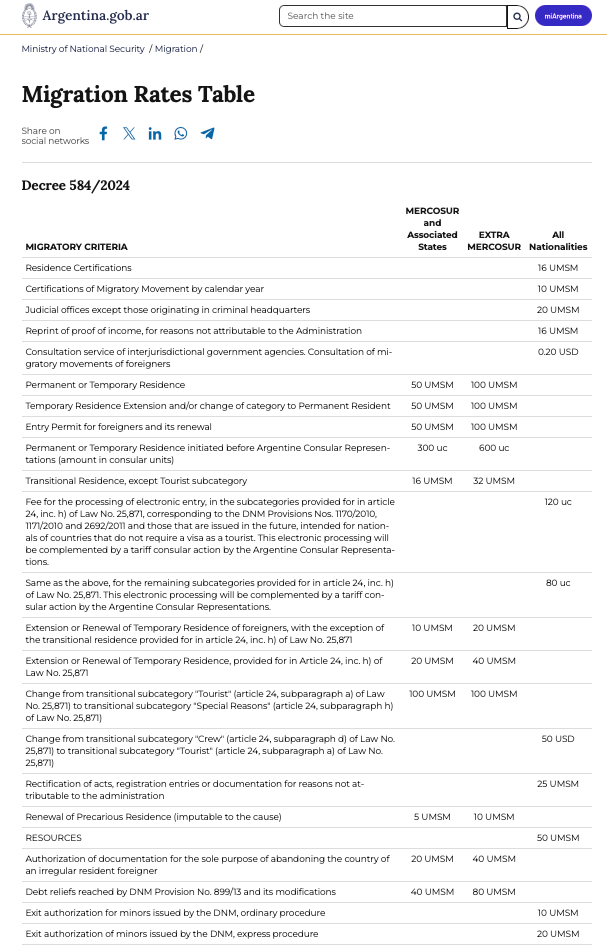
What it costs. The DNM fee table runs on Decreto 584/2024 and prices everything in UMSM units rather than pesos. Applying the unit value shown on the table itself (1 UMSM = ARS 1,000), the transitory-residence line items for non-Mercosur nationals land in the region of ARS 20,000–40,000, depending on which item applies to you.
Treat that as a range, not a quote. When the unit value is updated, every number on the table moves at once. Open the official fee table before you budget.
Overstaying in Argentina: the exit permit and what it really costs
A certain kind of long-stayer assumes they’ll sort it out at the airport on the way home. That improvisation has an official name: habilitación de salida, the exit permit.
Here is how it works:
- Once your permission has expired you are a residente irregular, and you must pay this fee before you can depart.
- The permit is valid for ten consecutive days from payment. Pay, then leave within ten days.
- Leave without paying and the amount is registered as an outstanding migration debt, which can block you from re-entering until it’s settled.
- On the fee table, the relevant non-Mercosur line item is 40 UMSM — around ARS 40,000 at the unit value published on the table.
The money is the smaller problem. The record is the larger one. An overstay goes on your immigration file, and that file is what gets pulled up when you apply for residency later or arrive at passport control next time. It is not “pay a fine and it’s gone.” It is “pay a fine, and it’s on file.”
Why the Argentina visa run stopped being a plan
For years there was a well-worn routine among foreigners in Buenos Aires: when the 90 days were up, take the ferry to Colonia or Montevideo, come back the next day, collect a fresh 90.
Decreto 366/2025, published in the Boletín Oficial in May 2025, went straight at that.
Article 10 of the decree amends article 35 of the immigration law so that entry can be refused at the border where the authorities find that “the real intention motivating the entry differs from the one stated.” In plain terms: if an officer concludes you’re coming to live or work rather than to visit, that is now an explicit, written basis to turn you around.
Be precise about what changed, though. Visa runs were not banned. Leaving and returning have always been two separate decisions, and re-entry was never a right. What’s new is that the grounds for saying no are now spelled out in the text. There are no stamps any more, but every crossing sits on the electronic record, and the more back-to-back tourist entries it shows, the more reason an officer has to start asking questions.
The practical read: using one border crossing to turn three months into six is still ordinary. Running that loop for years is no longer a plan, it’s a bet. If Argentina is where you actually intend to live, the honest move is to look at residency.

The health insurance declaration at the border
Article 9 of the same decree amends article 34 of the immigration law to require entering foreigners to declare that they hold health insurance “to cover their medical needs.”
Splitting the certain from the uncertain:
- Certain: the legal requirement exists (Ley 25.871 art. 34, as amended by Decreto 366/2025 art. 9).
- Uncertain: no published minimum coverage amount or required-benefits list turned up, and how often proof is actually requested at the airport is not something I can document.
- Worth knowing: when I checked, neither the US State Department nor the UK FCDO listed health insurance as an entry requirement on their Argentina pages. The State Department does strongly recommend travel insurance, noting that medical care “is not free in Argentina” and that most providers want payment up front.
Which makes the advice simple and cheap: carry your travel insurance certificate as a PDF and on paper. If nobody asks, you’ve lost nothing. If somebody asks and you don’t have it, you have a problem at the worst possible moment. For how the medical system itself works once you’re here, I’ve covered that separately in [INTERNAL LINK: healthcare in Buenos Aires guide].
What changed in 2025–2026, in one table
| Item | What it says | Source |
|---|---|---|
| Health insurance on entry | Must declare you hold medical cover | Decreto 366/2025 art. 9 (amends Ley 25.871 art. 34) |
| “False tourism” refusal | Entry may be refused where real intent differs from stated intent | art. 10 (amends art. 35) |
| Temporary residency lapses | After 6 continuous months outside Argentina | art. 16 (amends art. 62) |
| Permanent residency lapses | After 1 continuous year outside Argentina | art. 16 |
| Precaria certificate | Valid 90 days, renewable once | art. 5 (amends art. 20) |
| Citizenship provisions | Annulled by a court ruling in June 2026 | Cámara Nacional Electoral |
That last row deserves emphasis. The June 2026 ruling struck down the transfer of citizenship processing to the executive branch. It does not appear to have swept away the tourist and residency provisions with it — but it does mean this decree is not yet fully settled law. If your plans run all the way to citizenship, that is a conversation for an immigration lawyer, not a blog post.
If you’re staying longer than six months
Once 90 + 90 is used up, you’re in residency territory. Argentina has several routes — rentista and pension-based categories, a digital nomad category, student, work, and the Mercosur national route — and which one fits depends entirely on your paperwork and your passport.
The specifics are beyond this article and genuinely person-by-person. Two things are worth saying anyway:
Start while you still have time on the clock. Options narrow sharply in the last two weeks.
Keep your record clean. Someone applying with no overstay on file and someone applying with one are not starting from the same place.
[IMAGE PLACEHOLDER 3] alt: “Exterior of the Argentine national immigration office building in Retiro, Buenos Aires”
Frequently asked questions
Do US or UK citizens need a visa for Argentina? No, not for tourism of up to 90 days. The US rule is that your passport must be valid when you enter and have at least one blank page. The UK rule is that it must be valid for the whole of your stay. Check onward-ticket requirements with your airline.
Will I get a stamp in my passport? Not at airports or ports, which stopped stamping in 2022. Your entry is recorded electronically, and you can download a free record of your latest crossing from the Migraciones website.
How many times can I extend? The rule is “extendable for another similar period” — so one further 90-day block is the structure. Don’t build a plan that assumes you can keep renewing indefinitely.
How early should I apply for the extension? Within the 60 days before expiry. Aiming for two to three weeks out gives you room if something goes wrong.
Does a day trip to Uruguay reset my 90 days? It may produce a new entry permission — but it is not guaranteed. Re-entry is assessed each time, and since 2025 there is explicit authority to refuse entry where the stated purpose doesn’t match the apparent one.
I’m only a few days over. Can I just pay at the airport? There is a process — the habilitación de salida — and once paid you have ten days to leave. But it leaves a record. Don’t plan your departure on the assumption that it gets sorted at the gate.
Can I work while on a tourist stay? The tourist category is for rest and recreation. Working for an Argentine employer sits outside it. Remote work paid from abroad is a murkier question that depends on your circumstances; that one is worth a lawyer’s time.
What to do next
- Find out how many days you were actually given. Don’t assume 90. Download your entry record from Migraciones and put the expiry date in your calendar.
- Set a reminder 45 days out. That puts you comfortably inside the 60-day window.
- If you’re extending, open the official fee table first. The amounts move.
- Carry your insurance certificate. PDF and paper.
- If you know you’ll be here past six months, start looking at residency now — not in month five.
If you’re new here, start with the Buenos Aires first month survival guide and money in Argentina — exchange rates, cards and cash. If you’re planning to move around the country, Argentina domestic flights guide covers getting between cities. And if you’re looking for somewhere to live, there’s renting an apartment in Buenos Aires.